Don't Feed the Cats
It was toward the end of a dull and rainy day when I decided to take a walk. I was staying not far from the Montmartre cemetery, and I decided that I would take a turn around its leafy alley ways to get some air. The rain had kept me indoors for most of the day, but it was beginning to let up and I thought I could risk a stroll. I took an umbrella just in case.
I walked along the iron bridge of the rue Caulaincourt, a road built over the top of the cemetery, bisecting it in order to link two thoroughfares. From the elevated road, you can look down between the girders that form a wall and see the tombs below on either side. After I crossed the bridge, rumbling with constant traffic in the late afternoon, I turned down a set of stone steps to the cemetery entrance in a quiet cul de sac.
The part of the cemetery that was underneath the road was of course quite dry, being sheltered from the rain. I made a mental note in case the weather took a turn for the worse again and I needed to take cover. It is ironic that some of the tombs crowded under the girders of the rue Caulaincourt above bear some of the most illustrious names in Europe. Those must have been the most desirable sites when the cemetery first opened, but now they huddle beneath the bridge like homeless men. It would be like buying a penthouse apartment, only to have a helipad built on top, bringing constant noise, pollution, and crowds. I looked with curiosity at the tomb of Constance de Sax-Coburg Gotha. Who was she, exactly? The stone crown on the front of the tomb reminded me that that Saxe-Coburg family provided royalty for Britain, while the "who's who" of the aristocracy is still known in France as the "Gotha." Poor Constance could not have been better connected, yet today her unadorned grave bears telltale cobwebs: no one has touched it in years.
I turned away and ran my eye over the new sign nearby that listed the rules of the cemetery: no bicycles; no skate boards or roller blades; dispose of rubbish properly; don't feed the stray cats; etc. All the obvious things, but I suppose people still need to be reminded to be respectful.
I set off down one of the cobbled alleys that dropped away downhill to the left. It was, as I have said, late in the afternoon, and the clouds cast a gray and melancholy light. Rain still dripped copiously from the leaves of ancient horse chestnut trees. A couple of rooks were cawing loudly to each other as they flitted between the trees, but their mournful influence was mitigated by the cheery song of other birds who went about their business with no awareness that this was anything other than a quiet, hospitable park with plenty of places to nest and perch and very little to disturb them. I caught a flash of their color once in a while, but never quite enough to identify the species. They were mostly different from the ones I was familiar with back home, in any case.
There weren't too many other people around, perhaps on account of the rain, perhaps because it was a weekday, but I wasn't completely alone either. An occasional visitor—a leisurely couple with a baby in a stroller, an older couple, probably tourists, with a camera—crossed my path now and then, along with maintenance personnel in their distinctive green uniforms.
The Montmartre cemetery is an old and atmospheric place. It was created just after the French Revolution, in the late eighteenth century, so many of the tombs are two hundred years old or more. In addition, it was adapted from an old quarry and is situated on the side of a hill, so for many reasons, a lot of the graves are in a state of ill repair. Inscriptions have worn off, illegible headstones are covered in moss and lichen, the elements have done their work on masonry and statuary. Headless angels, amputated limbs, and toppled crosses all testify to the passage of time. And a combination of subsidence and ancient tree roots have done their part to upset the plans of the living that the dead should rest undisturbed for eternity. Despite the fact that certain tombs bear the inscription "concession à perpétuité" (plot in perpetuity), one feels that someone ought to have checked the fine print in the contract to see just how long said perpetuity is supposed to last. Not much longer than a couple of hundred years, to judge from the look of things.
Different parts of the cemetery are on different levels, like terraces, including one large square block that stands more or less in the middle, with uneven little steps leading up and down. As I walked along side one wall of this elevated section, I thought how fortunate it was that Paris has so few earthquakes. The old walls were already showing signs of cracks and erosion, and one good shake, I felt sure, would have the walls falling like those of Jericho and the dead spilling out in all directions, like molten lava flowing from a volcano. Neither spectacle was one I ever hope to see.
The thought jogged a memory at the back of my mind. I recalled Flaubert's description of his arrival in Jaffa on one of his exotic journeys around the Middle East. In the local cemetery, he wrote, he saw decomposing corpses bursting out of their graves, but the sight (and smell) was juxtaposed with that of the bright yellow fruit of the lemon trees, and Flaubert (perversely) found the spectacle not displeasing.
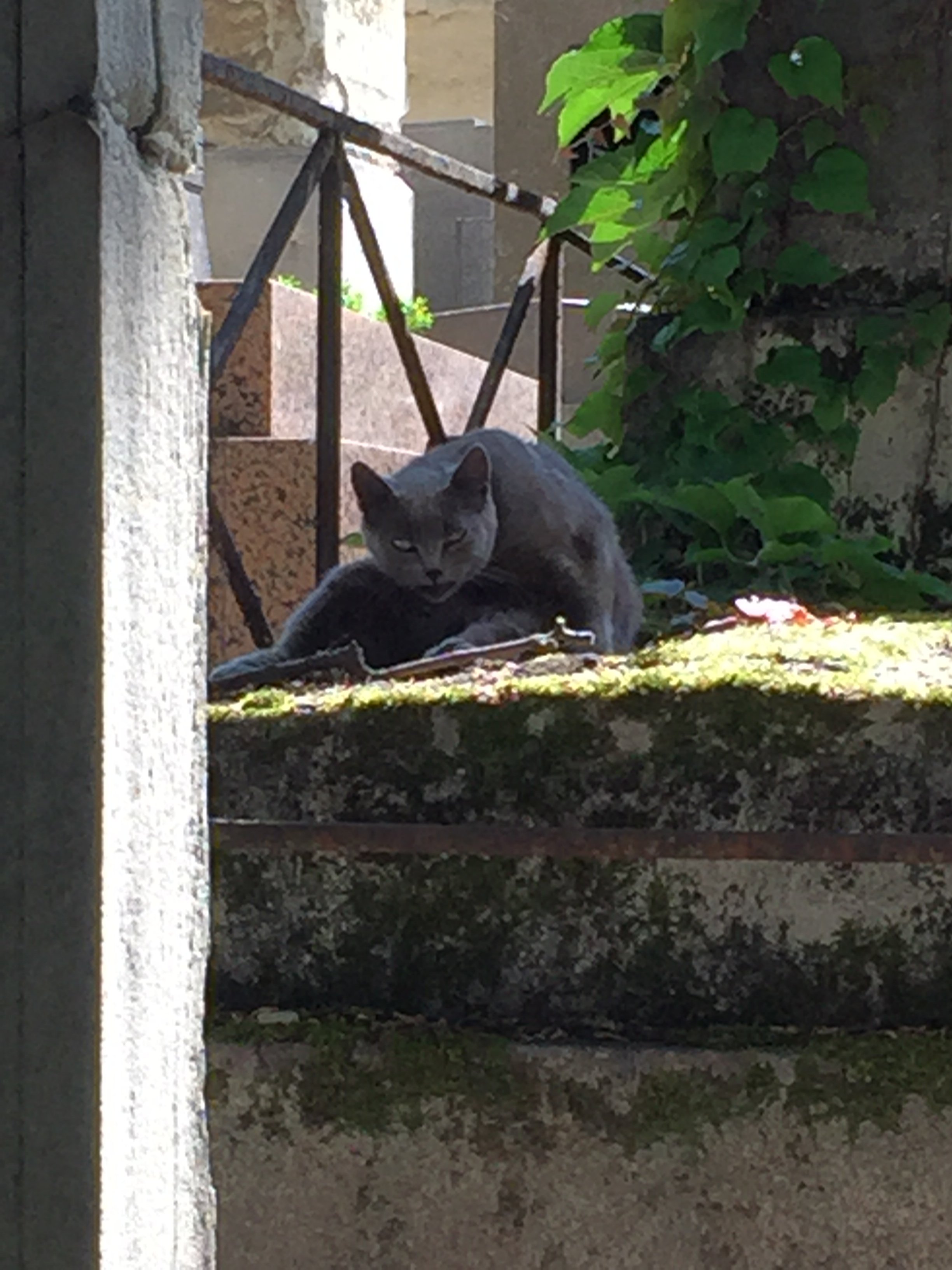
As I sauntered on, lost in such musings, a quick movement that registered in the corner of my eye caught my attention. I am not normally a superstitious person, but the furtiveness and the darkness of the small shadow that had glided by gave me pause. I stood rooted to the spot and turned to face the direction I thought the movement had come from. My attention was rewarded when, a moment later, I spied a gray cat slinking silently between two tombs the size of beach huts. The cat turned behind them, and I saw its tail disappear with a flick. Relieved that my imagination was not playing tricks on me, and that there was a perfectly good reason for dark shadows to be moving in a cemetery, I resolved to give the matter no further thought, but let out the breath I didn't realize I had been holding and continued on my way.
Now that I had noticed one cat, however, I began to see others. Perhaps they had been staying out of the rain, a bit like me, and now that the weather was improving, like me they came out to take some air. There was a tabby sitting on the slab of a tombstone a couple of rows over, swinging its tail nonchalantly as it looked around with ... well, with what I can only call morgue, a smug air of superiority.
These days, English speakers only know that word as the place where the dead are laid out for autopsy, but the word originally meant something very different. In the olden days when torture was a common, if not essential, element of the justice system, and when methods of execution were considerably bloodier that they are today, the gaoler would inspect the prisoner's body for any marks or peculiarities that could be used to identify it post mortem. One can only suppose that by the time the executioner had done his job, the face was no longer recognizable, but it was necessary to be able to demonstrate somehow that the right person had been executed, and that there had not been a last-minute switch to allow the condemned man (or woman, in the case of Joan of Arc) to escape. The gaoler, naturally, felt very superior to the prisoner, and looked down on him (or her), both literally and figuratively, and so the body inspection was conducted with no small amount of morgue: an attitude of superiority and disdain, of haughtiness and entitlement. And that was (and still is) called morgue. And really, the best way to get a feel for what it means nowadays, when most people seldom have occasion to rub shoulders with aristocrats, is to observe the behavior of cats, because they have morgue by the bucketful. Anyone who has been snubbed by a cat knows just what I mean.
Cats are nothing if not capricious and contradictory, however, and so it came as no surprise to see a black and white feline sitting in front of an ancient, pockmarked tomb bearing a pair of stained and eroded Egyptian pharaohs etched on the outside in bas relief. It was appropriate, I thought, given the reverence of ancient Egyptians for cats, but the cat seemed quite unaware of its exalted status. It perched quite unselfconsciously with one leg straight up in the air, licking its privates. Some cats have no sense of morgue.
I continued on down a leafy alley, stopping to reflect at the graves of the famous. I paused to touch the stone under which the writer Delphine de Girardin was buried with her media magnate husband Emile, the man credited with creating a mass market for newspapers. I smiled at the grave of the Goncourt brothers, the nineteenth-century equivalent of bloggers who wrote compulsively about everyone they saw and everything they did and heard in their tell-all diary. They finally bedded down together in the same grave in 1896 after being separated for 26 years when younger brother Jules passed away at the tender age of 40. Not all the graves were so antiquated. I reflected for a moment before the final resting place of film maker François Truffaut, a more recent addition. I'm sure he could have been buried in the more famous, more tourist-y Père Lachaise cemetery. I wonder what made him prefer this location to spend eternity.
Truffaut's gave was relatively new (as tombs go), but as I wandered around, I was reminded again of how many graves were in a rather more dilapidated state. Shifting ground created leaning towers of Pisa; subsidence pulled one stone apart from another, leaving troubling openings in otherwise hermetically sealed tombs; rain bathed the soft limestone so persistently that stone turned to water and melted away. One or two tombs had the municipal equivalent of bright yellow crime scene tape around them, warning people to stay away because the site was actually dangerous.
In some cases, the municipality went so far as to reclaim certain sites. Those concessions not purchased "in perpetuity" were only for a fixed period of time to begin with, but even the "perpetual" was subject to seizure if left to rack and ruin. Certain graves bore warning signs that repossession proceedings had been initiated. The occupants of these graves were on borrowed time. If no one--no one among the living, that is--came forward to claim them, they would be moved elsewhere to make room for the newly dead. I wondered what happened to the remains of the forgotten. Were they, for example, integrated into the charnel house of the catacombs of the Left Bank, where piles of skulls and femurs brought from ancient cemeteries all over Paris were stacked into morbid walls for curious tourists to visit?
I did not know where they went, but there were plenty of signs in the cemetery of recent evictions. I noted two or three bright plastic covers laid over what I assumed were empty plots awaiting new occupants. These lids were the same colour green as the uniforms of the cemetery workers, but they evidently belonged to a private company. I noted with irony that the company was called "Lecreux frères," or "Hollow Brothers." A perfect name for undertakers whose job was to fill in the "creux," or pit, under the temporary plastic roofs, pitched just like a roof over a little house to keep the rain from accumulating, which they thoughtfully provided to stop the unwary or the overly curious from falling, prematurely, into an empty grave. Amused by the punning name, I walked over to get a closer look at one of the green lids, scuffing the gravel on the path as I did so. But I jumped back when a startled cat darted out from beneath the cover. Taking advantage of one corner where the stone foundation sunk into the ground was broken, the animal must have taken shelter from the rain, but decided to make a run for it when it heard me coming. I suppose it didn't bother a cat the way it might bother a human to find itself crouching in a space that had housed dead bones for a couple of hundred years and now awaited a fresh delivery. The thought made me shudder somewhat. I found myself thinking that I was glad that the green lid covered up the sight of the empty, yawning grave, a sight that, in my imagination at least, seemed to draw me in with a vertiginous pull. In my head, I went from seeing an open grave, to falling in, to waking up buried alive, and before I knew it I was hearing the Rachmaninov fantasy that described, musically, the man who wakes up suddenly in a coffin and raps frantically to be let out until his forces fail him and he slowly lapses into silence. This dramatic piano piece had fascinated me as a child. No, clearly, cats were incapable of imagining such things.
Although the cat that had sprung out from under the temporary cover had surprised me, a little unpleasantly I must say, I was starting to become accustomed to their ubiquitous presence and the fact that they seemed to appear out of nowhere when least expected. I was standing looking at a grave so old and crumbling that all the broken stones had simply been gathered up and piled higgeldy-piggeldy on top of the slab when I noticed another presence, too: a middle-aged woman in a beige raincoat who was walking among the tombs, well off the beaten path. She moved slowly and silently, and as I watched she went over to one of the graves that resembled at little gothic chapel, pushed the rusty door open, and started trying to drag something out.
I was fascinated. She didn't look like your average desecrator or tomb-robber, and I couldn't imagine what she was about until it dawned on me: she was there to feed the cats. She was one of that army of kindly—and, I imagined, single and lonely—women who made it their mission to take care of strays. The Montmartre cemetery was famous for its felines and from what I had seen they were getting fed regularly and had nothing to complain of. I watched the woman go and rinse out a bowl at one of the communal water taps provided for friends and relatives of the deceased to maintain the resting places of their loved ones. She had short, brown curly hair, a sallow complexion, and hollow eyes, as though she was exhausted by some menial day job as a school cleaner or a hotel chamber maid. As she reached out to turn on the tap, I noticed that she also had a nasty gash on her arm, so I tried not to look as though I was staring. As she headed back to the tomb where she hid the cat food (so that she didn't have to haul it with her on each visit), I heard her say "Bonjour Camille" as a sleek young black and white cat padded up to greet her. Used to being fed, they probably all came running the minute they heard the rustle of the cat food bag, I thought.
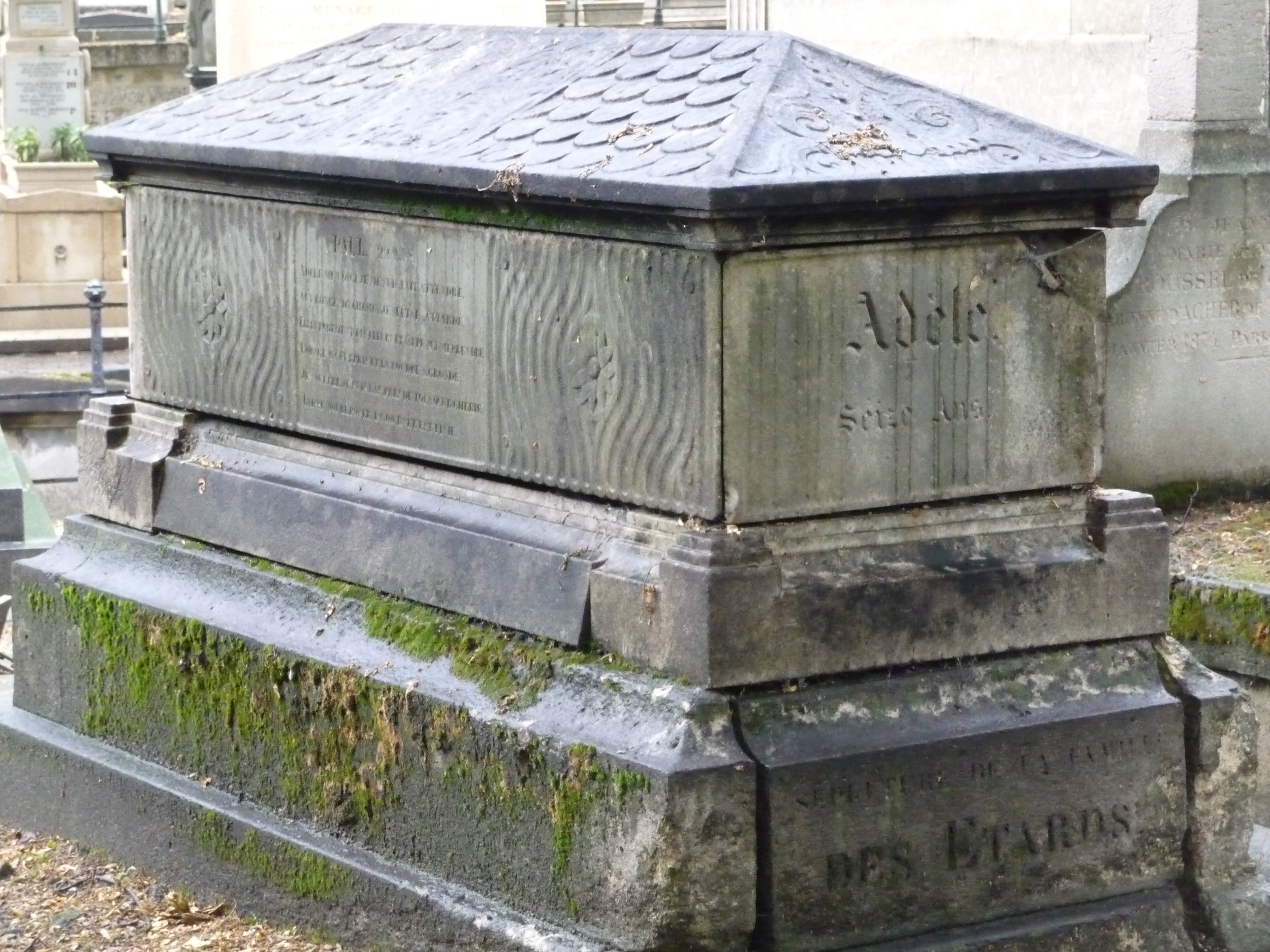
I continued on my walk, turning onto a parallel path that led back toward the entrance. A little farther on, a rather curious tomb caught my eye. It was unusual for its combination of decoration and simplicity. It resembled a stone box or coffin laid upon the ground with a pitched roof carved with scallops resembling domestic roof tiles. The sides of the box were incised with two panels, each one depicting vertical wavy lines bracketing a simple flower motif in the middle, like cartoony vibrations emanating from a ringing telephone or wood grain around a knot hole. I walked around the grave to get a better look. It was marked simply "Adèle. Seize ans." No last name for this girl, just that she died at sixteen as was, I imagined, missed. But rather than weeping angels or distraught parents or other images of nineteenth-century sentimentality, Adèle had received the tribute of a simple yet unique resting place.
I walked on, but suddenly found myself face-to-face with another "cat lady" who emerged onto the path from around the side of another massive gothic tomb. We had neither seen nor heard each other and nearly collided. "Pardon," I said, stepping aside to let her pass. I saw that she was carrying a plastic pet food bowl with some soggy kibble stuck to the bottom. She was evidently going to rinse it out before refilling it. My eyes traveled up from her outstretched hands to her face, and I noticed a fresh scratch on her cheek. Decidedly, these cats were an ungrateful lot. I wondered if the care of feral cats extended to trapping and neutering them, as it so often did at home, or if the feline denizens of the cemetery were left to mate at will, producing ever more kitty mouths to feed. Either way, the cat ladies had their work cut out for them.
I trudged on, tired now. The sprinkles of rain had made the paths muddy, and the weak afternoon light was starting to fade. I decided it was time to head back. I followed the path that turned at the bottom of the hill and began the ascent up the other side of the cemetery. I was about as far from the main entrance as it is possible to get. I passed a gray cat sitting on a kerbstone and licking its paw, oblivious of me; it had probably just eaten, I thought, and was now grooming contentedly. Another cat just ahead of me was startled by my approach and took refuge in a tomb where rust had eaten away enough of the heavily padlocked door to create an opening just big enough for a cat to slink in. The cemetery was indeed a haven for cats, with all its nooks and crannies. As long as you weren't fussy, there were all kinds of places to hide and shelter.
The light was starting to fade quickly. Although it was early summer and the sun would not set for at least a couple of hours, the rainclouds were thick and made for dreary weather. I was thinking ahead to the welcoming streetlights on the main road back at the entrance when I heard a short, sharp scream from behind a row of tombs up ahead.
With trepidation in my heart, I hurried around the corner, to the source of the scream. A cat lady was sitting on a low stone grave, her arm outstretched beside her. A long gash across the inside of her forearm was flowing freely with thick red blood. She was doing nothing to staunch the flow, but rested her arm on the tombstone. A black cat was lapping greedily at the wound. "Adèle, tu m'as fait mal, you hurt me," said the woman with resignation in her voice, making no attempt to withdraw her arm. The glossy cat paid no heed to the reproach, but continued to drink.
Although I had not been making any conscious effort to be quiet, my approach must have been softer than I thought, because I realized that neither the woman nor the cat had noticed me. Suddenly, whether it was the noise of gravel crunching underfoot or whether it was my movement that caught their attention, they both looked up and saw me. The cat sprang off the tomb, still licking its lips, and the woman hurriedly pulled a sleeve down over her arm and looked away self-consciously.
I made haste to move on and spare her embarrassment. As I walked on, I was still struggling to make sense of what I had just witnessed. A short distance ahead, I caught sight of the black cat disappearing into the corner of a grave. As I drew level, I saw that it was the tomb I had noticed earlier: Adèle, seize ans.